
News
The May 2026 Renters Rights Act Countdown
What Every Landlord and Tenant in North London Must Know Right Now
With The 'May 2026' Renters' Rights Act Countdown now firmly underway, the clock is running for landlords and tenants alike, and the stakes could not be higher. At present, an astonishing 17 households are competing for every single advertised rental property in England, a figure that makes the government's sweeping reforms feel both urgent and, for many renters, long overdue.

Frequently Asked Questions
|
|
|
|---|---|
|
When does the Renters' Rights Act take effect? |
1 May 2026 is the primary implementation date, applying to all existing and new tenancies simultaneously. |
|
Will Section 21 'no-fault' evictions be abolished? |
Yes. Section 21 notices will be abolished from 1 May 2026. Existing court claims must be active by 31 July 2026 or the notice becomes void. |
|
What happens to fixed-term tenancies? |
All tenancies will convert to rolling periodic tenancies. Fixed-term agreements will no longer exist for new or renewing lets. |
|
Can landlords still raise rents? |
Rent increases will be limited to once per year, and tenants will have a clear route to challenge above-market hikes via a tribunal. |
|
Are bidding wars being banned? |
Yes. Landlords will be legally prohibited from accepting offers above the advertised rent price. |
|
Does the Act apply to my existing tenancy? |
Yes. Unlike previous reforms, the May 2026 Act applies to all tenancies, both new and existing, from the same date. |
|
Where can I find landlord-specific guidance? |
Our dedicated landlord information pages cover the key obligations and services available to you. |
What Is the Renters' Rights Act and Why Does the May 2026 Deadline Matter?
The Renters' Rights Act is the most significant overhaul of private rental law in England in a generation. It passed through Parliament in late 2025 and sets 1 May 2026 as the central date when the majority of its reforms come into force.
Unlike previous tenancy legislation, which often offered transition periods and phased implementation, this Act applies simultaneously to all existing and new private tenancies. That means there is no gradual adjustment period; from 1 May 2026, the rules change for everyone, overnight.
What makes The 'May 2026' Renters' Rights Act Countdown particularly important is the sheer breadth of what is changing. From how tenancies are structured to how evictions are processed, from how rents are set to what physical condition a property must be in, the Act touches virtually every aspect of the landlord-tenant relationship.
For landlords and tenants in North and North-West London, where the rental market is especially competitive and property values are high, understanding these changes is not optional. It is essential.

The May 2026 Renters' Rights Act Countdown: Key Dates You Cannot Miss
Tracking the specific dates within this legislation is the first practical step for any landlord or tenant. The timeline below sets out the critical milestones as we count down to implementation.
-
Now (March 2026): Landlords have approximately five weeks to issue any final Section 21 notices, though this must be done carefully and with full legal compliance.
-
1 May 2026 ("Big Bang" Day): The core reforms take effect. Section 21 is abolished, all tenancies become periodic, and the new rent increase rules apply.
-
31 July 2026: The absolute cutoff for existing Section 21 court claims. Any claim not active in court by this date becomes legally void, regardless of when the notice was served.
-
Late 2026 (Phase 2): Awaab's Law timelines for damp, mould, and hazard repairs come into force for the private sector.
-
Ongoing from May 2026: The new Private Rented Sector Database begins mandatory registration requirements for landlords.
We strongly advise both landlords and tenants to keep up with the latest news and guidance as further regulatory detail is confirmed ahead of the May deadline.
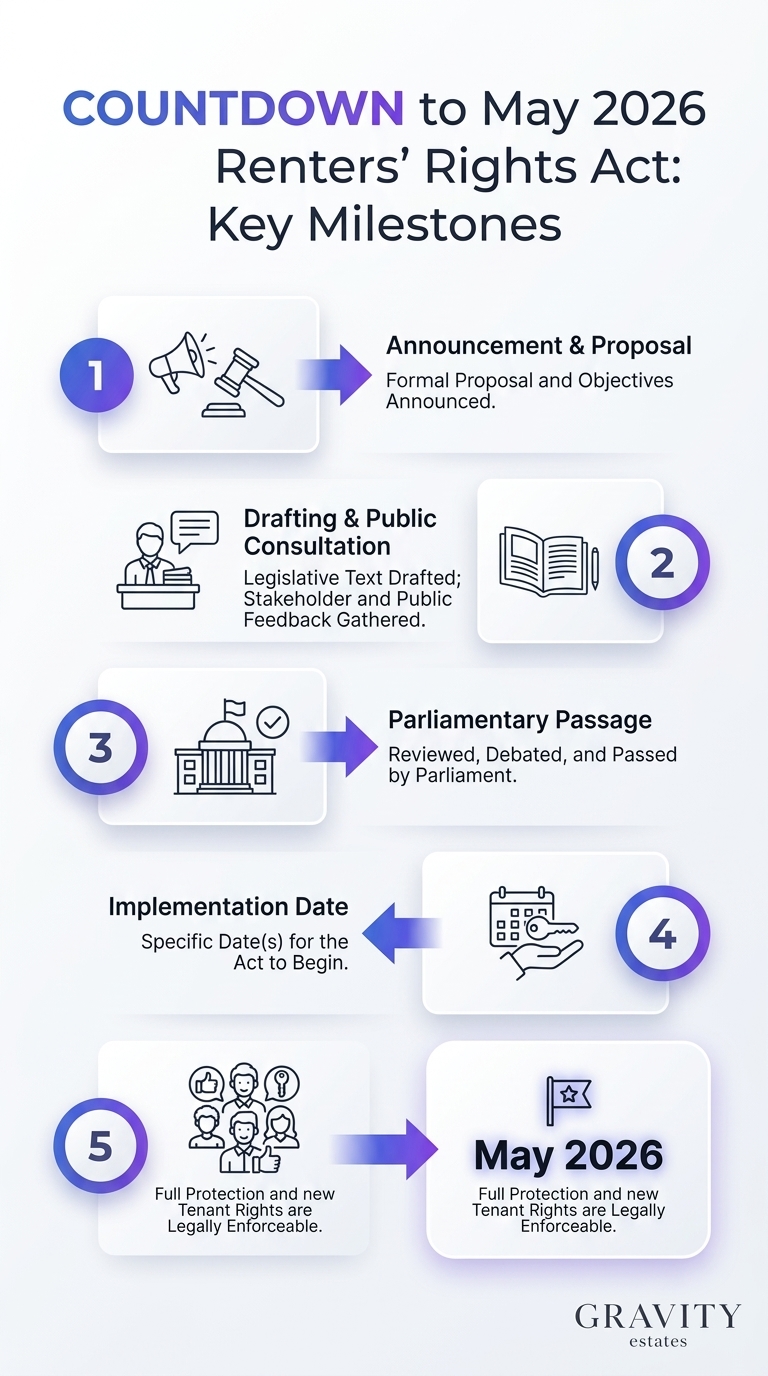
This infographic maps the countdown to the May 2026 Renters' Rights Act, highlighting major milestones and upcoming deadlines for tenants.
Section 21 Abolished: The End of 'No-Fault' Evictions Explained
The abolition of Section 21 is the headline reform within The 'May 2026' Renters' Rights Act Countdown. Currently, a Section 21 notice allows landlords to recover possession of a property without giving any specific reason, provided the required notice period is observed.
From 1 May 2026, this power no longer exists. Landlords who wish to reclaim their property will need to demonstrate a legally recognised ground for possession under the updated Section 8 framework.
The most commonly used Section 8 grounds include serious rent arrears, persistent late payment, antisocial behaviour, the landlord's intention to sell, or the need to move a close family member into the property. Each ground carries specific evidence requirements and notice periods.
It is worth noting that 71% of landlords have, in practice, never actually used a Section 21 notice. For many, the day-to-day management of their properties will not change dramatically. However, the legal framework they operate under will be fundamentally different, and preparation is key.
Critically, as noted above, 31 July 2026 is the absolute cutoff for existing Section 21 court claims. Even if a notice was served before 1 May, the corresponding court proceedings must be active by 31 July or the notice becomes legally void. This is a detail that carries serious consequences for landlords who have ongoing possession cases.
Did You Know?
39% of landlords are considering selling their properties within the next year, citing the Renters' Rights Act and regulatory uncertainty as their primary reason for exiting the market.
Source: Property Industry Eye

Periodic Tenancies: What the Shift Away from Fixed-Term Means in Practice
From 1 May 2026, all private tenancies in England will be periodic, rolling on a month-by-month basis. The familiar six-month or twelve-month fixed-term agreement will no longer exist as a legal structure for new or renewing tenancies.
For tenants, this change offers significantly greater flexibility. A tenant will no longer be locked into a fixed period. They will be able to give two months' notice to leave at any point after the tenancy begins, without penalty.
For landlords, this requires a different approach to tenancy management. The security of a guaranteed fixed income period, which many landlords have relied upon to satisfy mortgage lender requirements, will no longer be available in the same form.
Practically speaking, the majority of well-managed tenancies, where rent is paid on time and the property is respected, are unlikely to see frequent short-notice departures. The change is nonetheless significant, and landlords should review their financial planning accordingly. Our team at Gravity Estates is well-positioned to advise on the management structures best suited to your portfolio under the new framework.
Bidding Wars Banned: How the May 2026 Renters' Rights Act Countdown Targets Rent Competition
One of the most visible changes within The 'May 2026' Renters' Rights Act Countdown is the ban on rental bidding wars. The Act makes it unlawful for landlords or letting agents to invite, encourage, or accept offers above the advertised asking rent.
This reform directly addresses a practice that has become widespread in high-demand areas such as North and North-West London. Currently, 40% of renters have paid more than the equivalent of a standard month's rent upfront simply to secure a property ahead of competing applicants.
Under the new rules, the advertised price must be the actual price. Landlords will need to set a realistic market rent from the outset, as artificially low advertised prices intended to generate a bidding frenzy will also be prohibited.
Rents will also be restricted to one increase per year, and tenants who believe their rent has been increased above the market rate will have a clear route to challenge the decision via the First-tier Tribunal. This is a significant shift from the current position, where challenging a rent increase can be a complex and uncertain process.
For landlords working with us on our full letting service, we will ensure all advertised rents are set appropriately and compliantly from the outset.

The Decent Homes Standard and Awaab's Law: Physical Condition Requirements
The Renters' Rights Act extends the Decent Homes Standard, previously applicable only to social housing, to the entire private rented sector. This is a reform with wide-ranging implications, given that 21% of private rented homes in England currently fail to meet this standard.
In practical terms, a Decent Home must be structurally sound, free from serious hazards, have reasonably modern facilities, and maintain a reasonable state of repair. Landlords whose properties fall below this standard will be required to bring them up to compliance.
Awaab's Law, which mandates strict timelines for investigating and repairing damp, mould, and serious hazards, will be integrated into the Act's Phase 2 provisions, expected in late 2026. Presently, 3.6 million private renters are living in homes affected by damp and mould, a figure that underscores the urgency of this reform.
Landlords should carry out a thorough property condition assessment now, ahead of May, to identify and address any issues. Our property maintenance services can assist in coordinating the necessary work to bring properties up to the required standard.
For landlords who manage their own properties, we would recommend reviewing our maintenance calendar guidance to stay on top of scheduled inspections and repair obligations going forward.
What the May 2026 Renters' Rights Act Countdown Means for Landlords
The Renters' Rights Act introduces a new Private Rented Sector Database, which will require all landlords to register their properties and provide key information about compliance. Failure to register will carry financial penalties, and certain possession grounds will be unavailable to unregistered landlords.
A new Private Rented Sector Ombudsman will also come into effect, providing tenants with a free, independent route to resolve disputes without going to court. Membership will be mandatory for all private landlords.
It is also important to note that the May 2026 Renters' Rights Act Countdown is arriving alongside the Making Tax Digital reforms coming into effect this April, adding a further layer of administrative change for landlords with rental income. Staying organised and well-advised during this period is essential.
For those who manage their properties independently, this combination of reforms represents a significant increase in administrative and legal complexity. Many landlords are finding that the case for instructing a fully managed agent is now stronger than it has been in years. Our landlord management services are specifically designed to absorb this complexity on your behalf.
Did You Know?
73% of landlords expect the Renters' Rights Act to have a negative impact on their letting activity, suggesting a potential reduction in available rental stock across England as the May 2026 deadline approaches.
Source: LandlordZone

What the May 2026 Renters' Rights Act Countdown Means for Tenants in North London
For tenants, the Renters' Rights Act represents a significant strengthening of security and rights within the private rented sector. The abolition of Section 21 means that a landlord can no longer simply ask a tenant to leave without providing a legally valid reason.
The move to periodic tenancies gives tenants greater flexibility to move when their circumstances change, without the risk of being tied into a fixed term that no longer suits them. Combined with the restriction on rent increases to once per year, tenants will have greater predictability over their housing costs.
The ban on bidding wars will, in theory, create a fairer environment for prospective tenants. Rather than a competition based on who can offer the most money upfront, properties will be allocated on a more straightforward first-come, first-served or criteria-based approach.
Tenants will also gain access to the new Ombudsman service, providing a free and accessible route to resolve disputes over disrepair, deposit deductions, or other issues without the cost and complexity of court proceedings. For detailed guidance on tenant rights and obligations, our tenant information section is regularly updated with practical advice.
For any questions about deposits, our comprehensive guide on managing deposits explains how funds are protected and under what circumstances deductions may be made.
HMO Landlords and the Specific Implications of the 2026 Reforms
Houses in Multiple Occupation (HMOs) are subject to specific considerations within The 'May 2026' Renters' Rights Act Countdown. Each room in an HMO is typically let under a separate tenancy agreement, meaning that the shift to periodic tenancies will apply to each individual agreement within the property.
HMO landlords will also need to consider how the Decent Homes Standard and Awaab's Law apply to shared facilities such as kitchens, bathrooms, and communal areas. These spaces are often the source of damp and ventilation issues, and ensuring they meet the new standards is a priority task before May.
The new possession grounds under Section 8 will also function differently in an HMO context, particularly where antisocial behaviour or rent arrears involve one tenant within a shared household. HMO landlords will need specific legal advice to navigate these scenarios correctly.
At Gravity Estates, our letting and management services extend to HMO properties, and we can advise on compliance, licensing, and the specific adjustments required before the May deadline. This is particularly relevant given that our Rent Guarantee service also covers HMOs, providing an additional layer of financial security during this transitional period.

How Gravity Estates Helps Landlords and Tenants Navigate the Renters' Rights Act Changes
We are a professional, independent letting and sales agent based in Golders Green, specialising in the North, North-West, and North London area. We have guided landlords and tenants through legislative changes for many years, and The 'May 2026' Renters' Rights Act Countdown is the most significant change we have seen in the private rented sector in decades.
Our core letting services, Let Only, Full Management, and Rent Guarantee (including HMOs), are all structured to ensure compliance with current and incoming legislation. For landlords who prefer a hands-off approach, our Management service handles everything from tenant referencing and tenancy documentation to property inspections, maintenance coordination, and legal compliance.
We do not charge fees to tenants, and our fees to landlords are fully transparent with no hidden costs. All deposits held by us are registered with MyDeposits and held in a fully bonded designated client account, in line with legal requirements and best practice.
For landlords considering whether to retain or sell their rental properties in light of the incoming reforms, our team is well-positioned to provide an honest, local market assessment. If selling is the right decision for your circumstances, our property sales service can guide you through that process as well.
We recommend landlords who have not yet reviewed their tenancy agreements, compliance position, and property condition do so as a matter of urgency. Five weeks is a short window in which to address any gaps, and early action is always preferable to last-minute corrections.
The May 2026 Renters' Rights Act Countdown Requires Action Now
With just weeks remaining before 1 May 2026, The 'May 2026' Renters' Rights Act Countdown has moved firmly from something to monitor into something to act upon. For landlords, the changes to tenancy structure, possession grounds, rent increase rules, and compliance obligations represent a fundamental shift in how the private rental market operates.
For tenants, the Act delivers the strongest package of renter protections in a generation, including the abolition of no-fault evictions, a ban on bidding wars, greater rent stability, and new mechanisms for challenging substandard conditions.
The central message from the evidence is clear: the landlords and tenants best placed to navigate this transition are those who are informed, prepared, and working with experienced professionals. Whether you need guidance on restructuring your tenancy documentation, assessing your property's compliance with the Decent Homes Standard, or simply understanding what your rights and obligations are from May onwards, we are here to help.
Contact Gravity Estates today via our contact page, or speak directly with our lettings team. Our friendly and knowledgeable staff are ready to guide you through every aspect of the 2026 changes, ensuring that whatever your position, you are fully prepared for the road ahead.
Thinking of Letting a Property?
Call us now on 020 8357 0810