
News
How to Ensure Compliance with London Fire Safety Regulations
A Complete Guide for Landlords and Property Managers
Knowing how to ensure compliance with London fire safety regulations is one of the most critical responsibilities any landlord, property manager, or business owner in the capital carries in 2026, and the urgency has never been greater. A recent national audit found that only 57% of fire safety inspections were satisfactory, marking a 14-year low in compliance across the UK and suggesting that nearly half of all London buildings could fail a surprise inspection today.
At Gravity Estates, our team works closely with landlords across West, North-West, and North London to ensure properties remain safe, compliant, and well-managed at every stage. This guide brings together the most important steps, requirements, and practical measures you need to understand right now.
Key Takeaways
| Topic | Key Point |
|---|---|
| Legal Duty | Every landlord and responsible person has a legal duty under the Regulatory Reform (Fire Safety) Order 2005 to carry out a fire risk assessment. |
| Fire Risk Assessment | A documented fire risk assessment must be reviewed regularly, and immediately after any significant changes to the premises. |
| Fire Doors | In residential buildings over 11 metres, communal fire doors require mandatory quarterly inspections. Identified issues must be fixed within 14 days. |
| Alarms and Detection | Smoke and carbon monoxide alarms must be installed, tested, and maintained in all rental properties. Poorly maintained alarm systems contribute to 45% of false alarm call-outs. |
| Documentation | Records of all assessments, inspections, training, and remediation work must be maintained and available for inspection at all times. |
| New 2026 Risks | Lithium-ion battery fires in London increased by 28% in 2025. Risk assessments must now account for e-bike and device charging areas. |
| Professional Support | Working with a knowledgeable property management team helps landlords stay on top of evolving compliance requirements year-round. |
Understanding the Legal Framework Behind London Fire Safety Regulations
London fire safety regulations are governed by a layered framework of legislation that has been significantly updated following the Grenfell Tower tragedy and the subsequent Hackitt Review.
The primary legislation every responsible person must understand includes:
- The Regulatory Reform (Fire Safety) Order 2005 (RRO): Requires a written fire risk assessment for all non-domestic premises, including communal areas of residential buildings.
- The Fire Safety Act 2021: Clarified that the RRO applies to external walls, cladding, and flat entrance doors in multi-occupancy buildings.
- The Building Safety Act 2022: Introduced the concept of the "Accountable Person" and new duties for higher-risk buildings (those over 18 metres or 7 storeys).
- The Fire Safety (England) Regulations 2022: Added specific duties including quarterly inspections of communal fire doors and monthly checks of building fire safety systems.
Failing to comply with any of these instruments can result in enforcement notices, prohibition orders, unlimited fines, or even custodial sentences for responsible persons.
As a well-established team of Estate Agent Golders Green specialists, we at Gravity Estates ensure our managed properties stay ahead of every legislative update so our landlords are never caught off guard.
How to Ensure Compliance with London Fire Safety Regulations: Conducting a Fire Risk Assessment
The fire risk assessment is the cornerstone of London fire safety compliance. Without a current, documented, and suitable assessment, a property is immediately non-compliant regardless of any other measures in place.
A thorough fire risk assessment must cover the following five steps:
- Identify fire hazards: Sources of ignition (faulty wiring, cooking equipment, heaters), sources of fuel (furniture, paper, stored materials), and sources of oxygen (ventilation, air conditioning).
- Identify people at risk: This includes occupants, visitors, workers, and anyone with mobility impairments who may require a Personal Emergency Evacuation Plan (PEEP).
- Evaluate, remove, reduce and protect: Assess the risk level and take action to eliminate or reduce hazards, then put in place appropriate fire protection measures.
- Record, plan, inform, instruct and train: Document every finding, create an emergency plan, and ensure all relevant people know what to do in the event of a fire.
- Review and update regularly: Assessments must be revisited whenever the premises change, after any fire-related incident, or at least annually for most properties.
For landlords managing HMOs or multi-occupancy buildings, the assessment process carries additional complexity. Our maintenance and safety team coordinates with vetted contractors to support thorough, properly documented assessments on behalf of our landlords.
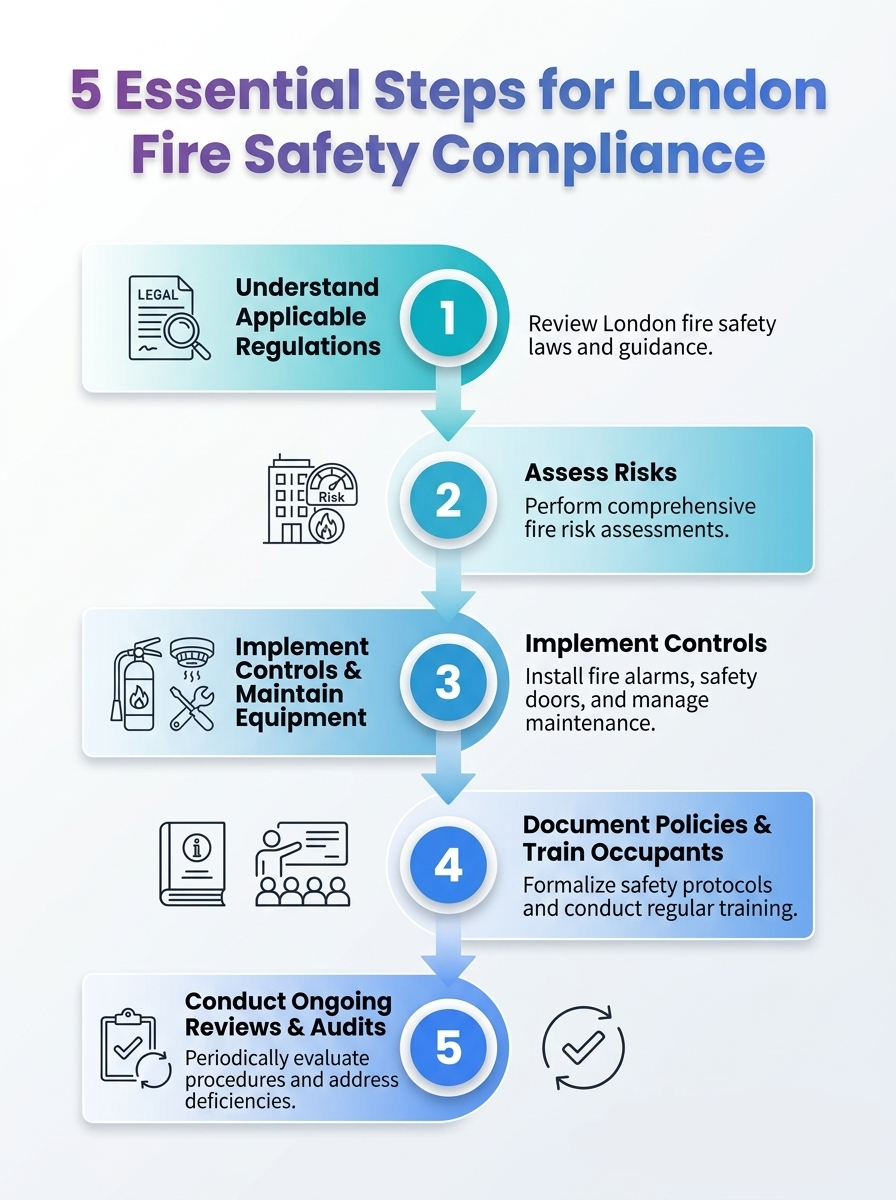
This infographic outlines the five essential steps to achieving compliance with London fire safety regulations. It highlights practical actions like risk assessment, proper documentation, training, regular reviews, and ongoing monitoring.
Fire Door Standards and Inspection Requirements for London Properties in 2026
Fire doors are one of the most frequently failed elements of any compliance inspection, and the statistics for 2026 make sobering reading for any property manager.
Under the Fire Safety (England) Regulations 2022, the following fire door inspection requirements apply in residential buildings over 11 metres:
- Communal fire doors must be inspected at least every three months (quarterly).
- Individual flat entrance doors that are fire doors must be checked annually, with residents given the opportunity to request a check by the responsible person.
- Any identified defects must be remediated within 14 days for commercial properties under 2025 guidance.
Common fire door failures include:
- Excessive gaps around the door frame (gaps exceeding 3mm)
- Damaged or missing intumescent seals
- Broken or absent self-closing devices
- Improper installation or incorrect door specification for the opening
- Doors wedged open with doorstops (a legal offence in certain settings)
Given that 70% of fire safety enforcement actions involve inadequate fire door maintenance, this is an area no responsible person in London can afford to overlook. Regular, documented inspections are not just best practice; they are a legal requirement.
Alarm Systems, Emergency Routes, and Equipment Maintenance
London fire safety compliance extends well beyond the fire risk assessment and fire doors. The broader fire protection systems within a building must be installed correctly, tested regularly, and maintained in full working order.
Smoke and Heat Alarms
The Smoke and Carbon Monoxide Alarm (Amendment) Regulations 2022 require:
- At least one smoke alarm on every floor of a residential property used as living accommodation.
- A carbon monoxide alarm in every room with a fixed combustion appliance (including gas boilers).
- All alarms to be tested at the start of each new tenancy.
Alarms must be properly maintained throughout the tenancy. Poorly maintained alarm systems contribute to 45% of false alarm call-outs attended by the London Fire Brigade, wasting emergency resources and potentially resulting in "nuisance alarm" penalties for property owners.
Emergency Routes and Exits
Emergency route and exit violations are the leading cause of fire safety audit failure in the UK, with over 10,000 breaches recorded annually. Landlords and managers must ensure:
- All escape routes are kept clear of obstructions at all times.
- Emergency lighting is installed and functional on all escape routes.
- Fire exit signs are clearly visible and illuminated.
- Escape routes are never used for storage, even temporarily.
Fire Extinguishers and Suppression Systems
Where fire extinguishers are provided, they must be the correct type for the fire risks present, installed at the correct height, and serviced annually by a competent engineer. For properties with sprinkler systems, monthly testing and documented maintenance records are essential components of how to ensure compliance with London fire safety regulations on an ongoing basis.
Record-Keeping and Documentation: A Critical Component of Compliance
One of the most commonly overlooked aspects of how to ensure compliance with London fire safety regulations is robust, ongoing documentation. Even if every physical measure is in place, the absence of proper records can lead to enforcement action.
Responsible persons should maintain documented records of:
- The completed fire risk assessment and all subsequent reviews
- All fire door inspection dates, findings, and any remediation works carried out
- Alarm testing dates and results
- Fire extinguisher service dates and engineer certificates
- Emergency evacuation drill dates and outcomes
- Staff and tenant fire safety training records
- Any correspondence with the London Fire Brigade or local enforcement authority
These records must be available for inspection at any time and should be retained for a minimum of three years. For higher-risk buildings under the Building Safety Act 2022, the "golden thread" of information requires even more comprehensive and permanently maintained documentation.
"A landlord has a duty to maintain their property and take reasonable steps to remove any hazards. Good documentation is what demonstrates that duty has been fulfilled." — Gravity Estates Landlord Guidance
Staff and Tenant Training for London Fire Safety Compliance
Physical measures alone are insufficient. Every person who uses or occupies a building must understand what to do in the event of a fire, and that knowledge depends on consistent, properly delivered training.
What Training Should Cover
- How to raise the alarm when a fire is discovered
- The location of all fire exits and assembly points
- The building's evacuation procedure, including any staged or phased evacuation protocol
- How to use a fire extinguisher safely (where applicable)
- The importance of keeping fire doors closed
- What to do if they discover a blocked exit or a faulty alarm
How Often Should Training Take Place?
For commercial premises, fire safety training should be conducted at least annually, with induction training for all new staff. Evacuation drills should be carried out at least once per year (twice for higher-risk premises) and the results documented.
For residential landlords, providing clear written fire safety information to tenants at the start of each tenancy is a straightforward but legally important step. Our tenant information service ensures renters receive practical guidance on alarms, escape routes, and reporting concerns from day one.
Emerging Fire Safety Risks Every London Landlord Needs to Know in 2026
Staying compliant with London fire safety regulations means keeping pace with new and evolving hazards, not just meeting the standards that were relevant five years ago.
Lithium-Ion Battery Fires
Lithium-ion battery fires in London increased by 28% in 2025, with 521 incidents recorded. This is now one of the fastest-growing fire risks in the capital, driven by the increased use of e-bikes, e-scooters, and rechargeable devices in residential and commercial properties.
Landlords and responsible persons should:
- Include lithium-ion battery storage and charging areas in fire risk assessments
- Prohibit the storage of e-bikes and e-scooters in communal corridors or escape routes
- Provide clear guidance to tenants on safe charging practices
- Consider installing specific detection systems in areas where battery charging regularly takes place
Higher-Risk Building Compliance
The Building Safety Act 2022 introduced a new regime for buildings over 18 metres, requiring registration with the Building Safety Regulator, appointment of an Accountable Person, and the creation of a comprehensive Safety Case Report. Any landlord with interests in taller residential buildings in North or North-West London should seek specialist advice on these additional requirements.
Ongoing Progress on External Wall Safety
84.3% of social housing buildings in London have now cleared life-critical fire safety defects related to external walls in 2026. However, roughly 1 in 6 buildings still have outstanding issues, and the remediation obligation continues to fall on building owners and responsible persons.
How Estate Agent Golders Green Landlords Can Ensure Compliance Year-Round
For landlords managing properties in Golders Green, Temple Fortune, Hendon, Hampstead Garden Suburb, and surrounding areas, ensuring continuous compliance with London fire safety regulations requires a structured, proactive approach rather than a reactive one.
The most effective strategies combine:
- Scheduled inspection cycles: Calendar quarterly fire door checks, annual alarm servicing, and annual fire risk assessment reviews so nothing is missed.
- Prompt remediation: Never defer identified defects. The 14-day remediation window for fire door issues means urgent action is a legal requirement, not simply good practice.
- Clear tenant communication: Tenants who understand their responsibilities, such as keeping fire doors closed and reporting defects promptly, are an active part of your compliance strategy.
- Professional property management support: Working with an experienced managing agent removes much of the administrative and compliance burden from individual landlords.
As a specialist Estate Agent Golders Green team, we at Gravity Estates operate a structured maintenance reporting system that connects landlords directly with vetted contractors for timely, well-documented remediation work. Tenants can submit issues through our straightforward online portal and receive prompt contact from a qualified professional with a reasonable, transparent quotation.
This end-to-end approach means nothing falls between the cracks, and landlords retain the documented evidence they need to demonstrate compliance at any time.
How to Ensure Compliance with London Fire Safety Regulations: A Practical Monthly Checklist
Breaking down compliance into regular, manageable actions makes it far less overwhelming. The table below outlines a practical schedule for landlords and property managers:
| Frequency | Action Required |
|---|---|
| Monthly | Test fire alarms; check emergency lighting; visually inspect escape routes for obstructions; check fire extinguisher indicators. |
| Quarterly | Formal fire door inspections (buildings over 11m); inspect self-closers, intumescent seals, and gaps; document all findings. |
| Annually | Review and update fire risk assessment; service fire extinguishers; test and service sprinkler or suppression systems; fire safety training for all staff; evacuation drill. |
| At Change | Review fire risk assessment after any change to the building layout, occupancy, or use; update emergency plans accordingly. |
| At New Tenancy | Test and confirm all alarms are working; provide written fire safety information to incoming tenants; check all fire doors in the property. |
Consequences of Non-Compliance with London Fire Safety Regulations
Understanding the penalties for non-compliance is just as important as knowing what steps to take. The London Fire Brigade and local enforcement authorities have wide-ranging powers to act against responsible persons who fail to meet their obligations.
Potential consequences include:
- Enforcement Notices: Requiring specific improvements within a defined timeframe.
- Prohibition Notices: Immediately restricting or prohibiting the use of all or part of a premises.
- Unlimited Fines: Magistrates and Crown Courts can impose fines with no upper limit for serious breaches.
- Custodial Sentences: Responsible persons can face up to two years in prison for the most serious failures.
- Civil Liability: Where injury or death results from a failure to comply, civil claims can run to very significant sums.
Schools and hospitals already face average penalties of £15,000 for serious fire safety breaches. For commercial landlords and property managers in London, the financial and reputational consequences of non-compliance are simply not worth the risk.
Taking Compliance with London Fire Safety Regulations Seriously in 2026
Knowing how to ensure compliance with London fire safety regulations is not a one-off task; it is an ongoing commitment that touches every aspect of property ownership and management. From thorough fire risk assessments and regular fire door inspections to proper alarm maintenance, staff training, and meticulous documentation, every step matters and every omission carries risk.
With national audit satisfaction rates at a 14-year low in 2026, the gap between compliant and non-compliant properties has never been wider. Whether you own a single buy-to-let apartment in Golders Green or a portfolio of HMOs across North-West London, the principles remain the same: assess, document, act, and review.
At Gravity Estates, we take these responsibilities seriously on behalf of every landlord we represent. Our end-to-end property management service, combined with our extensive knowledge of the local market across Golders Green, Hendon, Temple Fortune, and Hampstead Garden Suburb, means our clients can rely on us to help them stay compliant, informed, and protected.
To discuss how we support landlords with fire safety compliance and property management in North-West London, please get in touch with our team at 020 8357 0810 or via sales@gravity-estates.com. As a trusted Estate Agent Golders Green specialist operating under the standards of The Property Ombudsman, we are here to provide the individual, high-quality advice your property deserves.
Frequently Asked Questions
What are the main London fire safety regulations a landlord must comply with in 2026?
The primary obligations fall under the Regulatory Reform (Fire Safety) Order 2005, the Fire Safety Act 2021, the Fire Safety (England) Regulations 2022, and the Building Safety Act 2022. Knowing how to ensure compliance with London fire safety regulations means understanding all four of these instruments and how they apply to your specific property type and height.
How often does a fire risk assessment need to be reviewed in a London rental property?
A fire risk assessment should be formally reviewed at least once a year for most rental properties, and immediately after any significant changes to the premises, its use, or its occupants. It must also be reviewed following any fire-related incident, however minor.
Do I need a fire risk assessment for a small HMO in North London?
Yes. All Houses in Multiple Occupation (HMOs) require a written fire risk assessment regardless of size, and the assessment must be carried out by a competent person. HMOs carry higher fire risks due to multiple occupants sharing common areas, and compliance with London fire safety regulations in this context is particularly closely monitored.
How often should fire doors be inspected in a residential building in London?
Under the Fire Safety (England) Regulations 2022, communal fire doors in residential buildings over 11 metres must be inspected at least quarterly. Individual flat entrance fire doors must be checked annually. Any defects discovered must be remediated within 14 days for commercial properties to maintain compliance.
What happens if a London landlord fails a fire safety inspection in 2026?
Failure to comply with London fire safety regulations can result in enforcement notices, prohibition of use, unlimited fines, or even a custodial sentence for the responsible person. Beyond legal penalties, non-compliance also creates significant civil liability exposure if a tenant or visitor is harmed.
Is a fire safety certificate still required for rental properties in London?
The formal "fire certificate" was abolished under the Regulatory Reform (Fire Safety) Order 2005. Instead, landlords must maintain a current, documented fire risk assessment and records of all inspection and maintenance activity, which together serve as the evidence of compliance expected by enforcement authorities.
What new fire safety risks should London landlords assess in 2026?
Lithium-ion battery fires are the fastest-growing new risk, having increased by 28% in London in 2025. Landlords should now specifically include e-bike and e-scooter charging areas in their fire risk assessments and provide clear guidance to tenants about safe charging practices to ensure ongoing compliance with London fire safety regulations.
Thinking of Letting a Property?
Call us now on 020 8357 0810